How they think:
the internal story of self-doubt.

Learn Dr. Lisa Orbé-Austin's research-backed 3C's Methodology, a proven framework that creates measurable reductions in Imposter Syndrome and lasting behavioral change.

.png?width=75&height=103&name=Vector%20(6).png)

.png?width=75&height=107&name=Vector%20(7).png)
.png?width=150&height=118&name=Vector%20(8).png)
.png?width=120&height=52&name=Vector%20(9).png)
.png?width=100&height=99&name=Vector%20(10).png)
You can already recognize Imposter Syndrome in a client. The high achiever who calls every win luck. The executive who over-prepares for a meeting they could lead cold. The one who hears praise and quietly sets it aside. You name the pattern. You ask the question that makes them pause. They have a real moment of clarity, and they leave the session lighter.
Two weeks later, the same client walks back in, running the same loop. It happens because awareness was never the missing piece. Your client could describe their Imposter Syndrome before they booked the call. They have read the articles. They can name the fear. And they still cannot stop the behavior, because understanding a pattern and interrupting one are different kinds of work.
Coaching this well takes more than instinct and encouragement. It takes a method built for the actual shape of the pattern.
A 25-week certification that gives coaches a structured, research-informed way to move clients past recognition and into measurable, lasting change. Built and delivered by Dr. Lisa Orbé-Austin, a licensed psychologist and a leading authority on Imposter Syndrome, it is organized around one repeatable framework you can apply across very different clients: the 3C's Methodology.
15-day money-back guarantee
Imposter Syndrome is usually treated as a lack of confidence. That's why so much coaching on it doesn't hold. Four decades of peer-reviewed research point to something different: this isn't a confidence gap. It's an identity-level pattern that runs through four parts of a person at once.
How they think:
the internal story of self-doubt.
How they act:
overpreparing, avoiding, procrastinating.
The story they tell about themselves:
"I got lucky," "I'm not really qualified."
How they show up with other people:
seeking approval, avoiding exposure.
Fixing one part doesn't fix the pattern, because the other three are still running the old program. A confidence reframe only touches one of these four parts. That's why the gains disappear between sessions: the other three parts never got the message.
Underneath this pattern is one core belief: my worth isn't something I have, it's something I have to keep proving or being told. When a client hears "you are good enough," it feels good in the moment. But it also confirms the belief driving the whole pattern - that their worth depends on someone else supplying it. The coach hasn't challenged the belief. They've fed it. Durable change requires a method that works on all four parts at once, and reshapes the belief instead of providing more evidence for it.
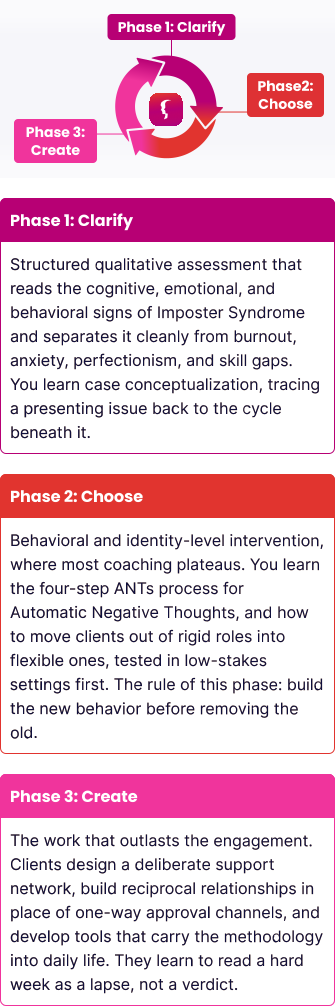
A repeatable, research-informed framework. 3 phases: Clarify, Choose, Create - always in this order, because each phase depends on the one before it.

A repeatable, research-informed framework. 3 phases: Clarify, Choose, Create - always in this order, because each phase depends on the one before it.
15-day money-back guarantee
By the time a client reaches you, the internet has handed them a story about Imposter Syndrome. Usually one of three. Each one quietly works against the coaching, because each one tells the client the pattern cannot, or should not, change. Knowing how to address them is part of the work.
"It is just my type."
The client took a quiz and got sorted into a fixed Imposter Syndrome type: the Perfectionist, the Expert, the Soloist, whatever the label. It felt like insight. It landed as a verdict: this is simply who I am, so there's nothing to coach. The 3C's replace the label with something workable. There's one underlying pattern, and that pattern shows up through different roles depending on the situation. Roles can change because they were never who the client is. They're just where the pattern happened to show up.
"It is my superpower."
The client believes self-doubt is what drives their success. The fear of not being good enough is the engine behind their achievement. So letting it go doesn't feel like healing, it feels like losing their edge. They resist the work to protect the thing they think is making them succeed. The research shows Imposter Syndrome tracks with anxiety, burnout, and fear-based effort, not with healthy ambition. What the client is calling their "drive" is actually a stress response: working from fear of exposure, not desire for growth. That distinction is what frees the client to do the work.
"It's all in my head."
The client believes the fix is a mindset shift and simply requires the right reframe, the right affirmation, the right thought repeated enough times. So they wait for it. And when it doesn't hold, they assume they just haven't found the right words yet, and keep looking. But this isn't a thoughts-only pattern. It runs through behavior and relationships, too. This is why a new thought, on its own, has nothing to attach to. The old behavior is still there. The old relational habits are still there. The 3C's show the client this directly, then give them what a belief shift actually needs to hold - not just new language for the same pattern.
Each one of these beliefs creates resistance you will need to navigate. This certification gives you a clear, research-grounded approach to address these limiting beliefs and create the environment for them to truly thrive.
15-day money-back guarantee
Coaches reported raising their rates after adopting the methodology, pricing for a specialization rather than a general practice.
Engagements extended from roughly 3 to 6 months, because the work keeps producing change instead of plateauing at insight.
Continuing Coach Education Units toward ICF renewal, plus a recognized designation that signals your specialization.
The certification runs from September 29, 2026, to March 2, 2027, delivered live online. The structure below shows the program's shape. Exact session dates and times are confirmed at enrollment.
| Arc | Sessions |
|---|---|
| Kickstart |
One pre-recorded module (Module 0), available the moment you enroll. |
| Essentials and Core Methodology (Modules 1 to 7)
|
Seven modules covering the foundations: identifying Imposter Syndrome and distinguishing it from anxiety, burnout, or skill gaps, running a structured assessment, and applying the 3C's Model to help clients challenge negative thinking and take their first steps toward change. |
| Practicum Sessions |
Three live applied-practice sessions across the foundational arc. |
| Advanced Application (Modules 8 to 11) |
Four modules on advanced work: spotting Imposter dynamics in session, applying the 3C's Model across complex presentations, interrupting patterns at the identity level, rebuilding self-narrative and internal validation, designing behavioral experiments, and building relapse prevention. |
| Tag-Team Coaching Sessions |
Four live co-coaching sessions across the advanced arc. |
| Capstone |
One Capstone Project, completed for the designation. |
15-day money-back guarantee
Surface the roots and triggers of Imposter Syndrome. These tools help clients examine personal narratives and reframe self-perception.
Help clients make intentional, growth-oriented decisions. The central tool, Automatic Negative Thoughts, guides clients through recognizing, classifying, disputing, and replacing common distortions.
Help clients design environments that sustain resilience. These tools build support networks and reinforce change in daily life.
15-day money-back guarantee
.png?width=105&height=117&name=bonus1%20(1).png)
A layered case to work through. A client moving into a leadership role arrives with real signals across burnout, perfectionism, low confidence, and anxiety, all at once. This is the kind of mixed presentation that shows up in actual discovery calls, where nothing sorts cleanly into one box. You read the case, apply the question from the Guide, and practice separating the patterns before you decide where to start.
.png?width=105&height=117&name=bonus2%20(1).png)
A full recorded session that shows how Lisa coaches the 3C's in a real room. It pairs with the Application Exercise: you read the case on paper, then hear the method spoken, paced, and applied. Reading a framework and hearing it work are two different things, and this gives you both.
15-day money-back guarantee
This certification is built for professional coaches who already see Imposter Syndrome in their clients and want a method instead of instinct.
If the first list sounds like your practice, you are who this was built for.

The Shift
You recognize Imposter Syndrome and coach it on instinct. Some engagements move, some plateau, and the ones that stall get filed under timing or readiness. Your positioning stays general, and your rates stay with it.
You work from a defined method. You assess the pattern early, conceptualize the case, and intervene at the behavioral and identity level. Engagements hold longer because the work keeps producing change. You carry a recognized designation and a peer network trained the same way.
Past participants repeatedly reported an unexpected "second shift." As they mastered this work with clients, they naturally began transforming similar patterns within themselves.
Founder & Executive Coach, CORDET Solutions

Coach

ICF-PCC Coach, Career and Leadership

Executive & Leadership Coach
Executive Coach

Founder and CEO
Leadership Coach
Participant

Imposter Syndrome Coach
Organizational Consultant & Executive Coach
Executive Leadership Coach
Imposter Syndrome Practitioner Graduate

Dr. Lisa Orbé-Austin is a licensed psychologist and executive coach with around 20 years in practice, specializing in Imposter Syndrome, career advancement, and DEI. She holds a doctorate in Counseling Psychology from Columbia University, Teachers College, and co-founded Dynamic Transitions Psychological Consulting with her husband, Dr. Richard Orbé-Austin.
She is a co-author of three books on Imposter Syndrome and career development: Own Your Greatness (2020), Your Unstoppable Greatness (2022), and Your Child's Greatness (2025).
Own Your Greatness was a finalist, while Your Child's Greatness won the Indies Forward Book Award. She delivered the famous TEDxDeerPark talk The Imposter Syndrome Paradox, which has reached over 1.5 million views across platforms. She contributed the chapter to the American Psychological Association (APA) volume edited by Kevin Cokley, The Impostor Phenomenon: Psychological Research, Theory, and Interventions.
She is a 2X LinkedIn Top Voice and was named to the inaugural Thinkers50 Coaches50 list.
One certification, one price. Everything below is included.
Super Early Bird Ends on September 10, 2026.
Your risk is covered. The certification carries a 15-day money-back guarantee from the date the course starts. The Kickstart module and Module 1 materials open the moment you enroll, so you can experience the methodology directly and decide with real information. If it is not the right fit inside that window, you are refunded.
The Practicum and Tag-Team Coaching format depends on a working group size, so each cohort holds a limited number of seats. When they are filled, the next opportunity is the following cohort, roughly six months out.
Email us at [email protected]
Book a meeting and we’ll call you!
Call us or send us a message
+1 415 228 6857
BOOK A CALL
Yes. This certification is designed to deepen and expand your existing expertise, not repeat foundational coaching skills. You’ll learn how to identify Imposter Syndrome more precisely, distinguish it from general self-doubt or confidence issues, and apply a research-backed methodology to patterns that can persist even in highly successful clients.
For experienced executive, leadership, career, and organizational coaches, it adds a specialized capability for working with a challenge that frequently shows up in high performers.
No. You do not need to hold an ICF credential or have years of coaching experience to participate. The program provides a structured methodology, practical tools, live learning, and guided practice to help you build confidence applying what you learn.
It is well suited to newer coaches developing a credible specialization, as well as experienced practitioners expanding their expertise.
Upon successfully completing the certification requirements, you will be equipped to identify Imposter Syndrome patterns, recognize common triggers and cycles, and apply Dr. Lisa Orbé-Austin’s research-backed 3C’s Methodology to help clients create meaningful, lasting change.
You’ll leave with a specialized framework and practical tools you can integrate into your existing coaching practice.
Imposter Syndrome is not simply a lack of confidence or a negative mindset. Many clients already have extensive evidence of their competence, yet continue to minimize, discount, or explain away their success.
This certification teaches you to recognize and work with the deeper patterns that keep Imposter Syndrome in place, rather than relying only on reassurance, reframing, or confidence-building strategies.
Yes. The program is designed for practical application, with tools, frameworks, and structured approaches you can begin integrating into your coaching work as you progress.
In the previous cohort, participants reported using tools with clients before the program had even ended, and immediate practical applicability emerged as one of the strongest themes in participant feedback.
This certification can help you build a clear specialization around a highly relevant challenge affecting leaders, high performers, and professionals navigating growth and advancement. You’ll gain a research-backed methodology, practical tools, and a more structured way to address client needs that may otherwise be mistaken for general confidence or mindset issues.
For some coaches, this specialized expertise may support higher-value coaching offers, greater confidence in increasing their rates, stronger differentiation in a crowded market, or new opportunities with individual and organizational clients. It can also help you articulate your value more clearly by giving you a defined problem you are equipped to solve.
Your results will depend on how you apply, position, and market the expertise you gain, but the goal is clear: to help you leave with a capability you can integrate into your practice, not simply another credential to add to your resume.
For many coaches, yes. As you learn to identify Imposter Syndrome patterns in clients, you may also recognize how those patterns show up in your own work, leadership, visibility, pricing, or professional identity.
Participants in the previous cohort consistently described the experience as both personally transformative and professionally valuable.
The program is designed to fit alongside an active coaching practice. You should plan for approximately 2-3 hours per week, including live learning, independent study, and practice.
All core live teaching sessions are recorded, so if you cannot attend one live, you can catch up with the replay. Practice sessions are the exception and must be attended live, because they are designed for active participation, skill application, and real-time learning with other coaches.
To earn your certification, you’ll need to complete the required learning components, meet the live practice-session attendance requirements, and successfully complete any required assessments or certification activities outlined in the program.
Yes. Imposter Syndrome frequently appears in high-performing professionals, emerging leaders, executives, and people navigating increased visibility, advancement, or complex workplace dynamics.
The methodology can complement executive, leadership, career, and organizational coaching by helping you work more precisely with patterns that may otherwise be mistaken for general confidence issues.